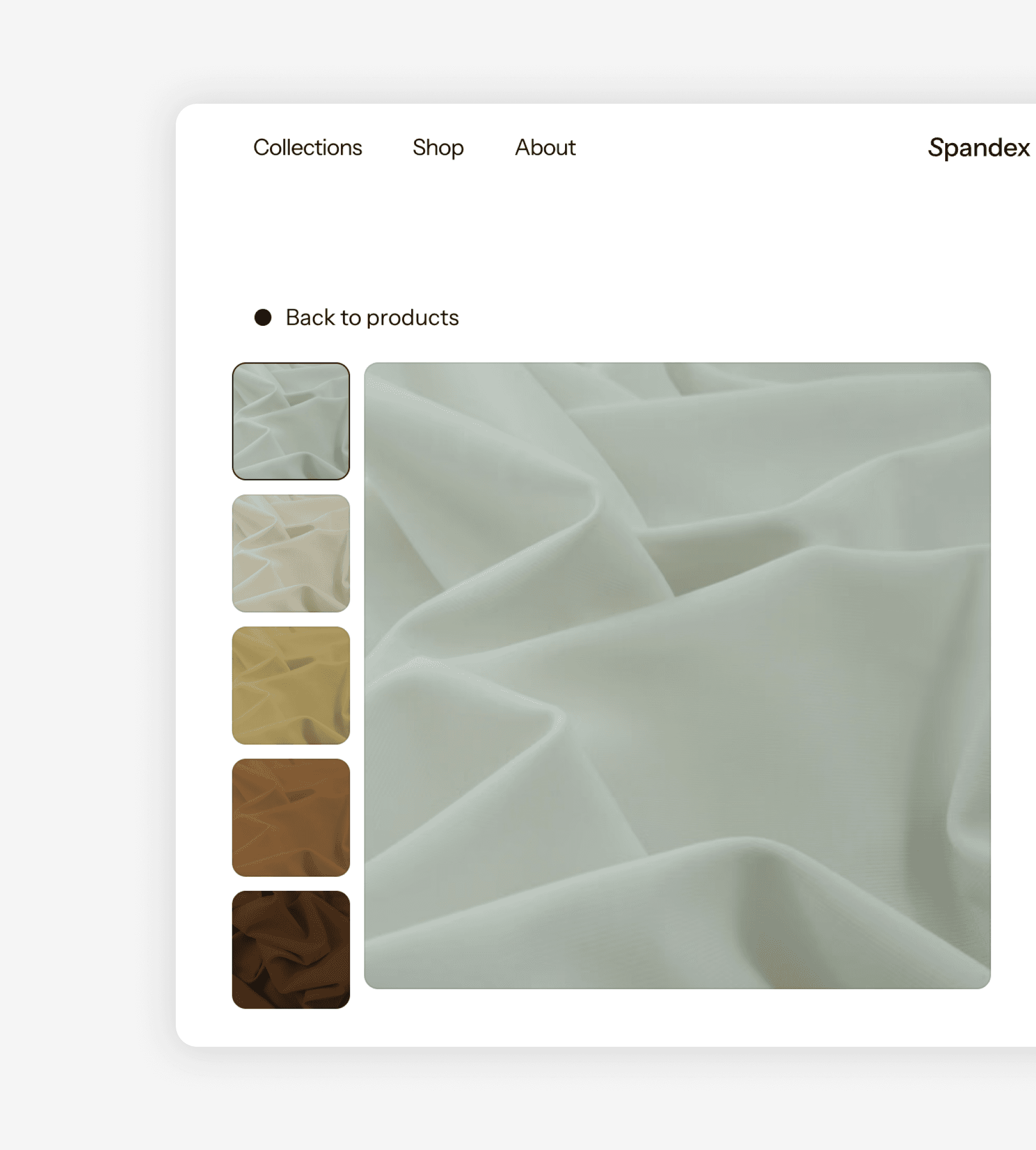
Spandex Global is an e-commerce wholesaler specializing in spandex fabrics. Despite steady traffic, the business was struggling with high bounce rates, low conversions, and stagnant sales. The issue wasn’t demand, but rather friction. Users were landing on the site, but the experience wasn’t carrying them through to purchase.
I was brought in to diagnose and redesign the end-to-end shopping journey, with a focus on reducing friction and rebuilding trust at every step.
Through usability testing and heat-map analysis, patterns quickly emerged. Navigation was unclear and forced users to hunt for products. Product pages lacked hierarchy and confidence-building detail. The checkout flow was long, fragmented, and cognitively heavy, averaging nearly five minutes to complete. Small inefficiencies compounded into abandonment.
The core challenge was clarity. Buyers needed efficiency and reassurance, not visual noise. I reframed the experience around one guiding principle: every click should feel obvious and necessary.
I began by restructuring the navigation to better reflect how customers actually browse, by fabric type, weight, and use case, rather than internal product categorizations. Product pages were redesigned with clearer hierarchy, simplified descriptions, stronger imagery, and more prominent purchasing cues.
The checkout flow was streamlined into a tighter, more linear process, with express checkouts for returning customers. Redundant steps were removed, form fields were reorganized, and visual feedback was strengthened to reduce hesitation. The goal wasn’t just speed. It was also confidence. Users needed to feel certain their order was correct before committing.
In parallel, I led a light but intentional rebrand. The previous identity felt dated and inconsistent. We shifted toward a minimalist, friendlier visual language that felt modern and approachable while still credible for buyers. The brand update supported the UX changes by reducing visual clutter and reinforcing trust.
I delivered:
A restructured navigation aligned to buyer mental models
Redesigned product pages with stronger hierarchy and clearer bulk purchasing cues
A streamlined checkout flow reducing time-to-purchase from 5 minutes to under 2
A minimalist, cohesive rebrand to improve clarity and approachability
The impact was measurable:
35% increase in conversion
Doubled number of returning customers
Significant reduction in checkout abandonment
This project reinforced a principle I apply across products: optimization isn’t about adding features; it’s about removing hesitation. By clarifying structure, simplifying decisions, and aligning the experience with how customers actually think, we turned existing demand into measurable growth.