Verafy AI Compliance Tool
Product Design Lead
September 2025
Verafy AI Compliance Tool
Product Design Lead
September 2025
Verafy is an AI-powered compliance tool designed to help Ontario real estate agents confidently navigate transaction requirements without memorizing forms, edge cases, or regulatory nuance. The product had to solve a high-stakes problem: agents needed speed and certainty, while regulators and brokerages demanded accuracy and completeness. I led the product and experience design, with a focus on its core differentiator, translating complex regulatory logic into a guided, error-resistant workflow.
The problem wasn’t lack of information. Agents already had access to forms, checklists, and brokerage guidance. The real issue was cognitive load. Determining which forms were required depended on a tangled web of variables: property type, transaction type, representation structure, conditional clauses, and edge cases that changed obligations entirely. One wrong assumption could invalidate a deal. Compliance lived in agents’ heads, not in systems.
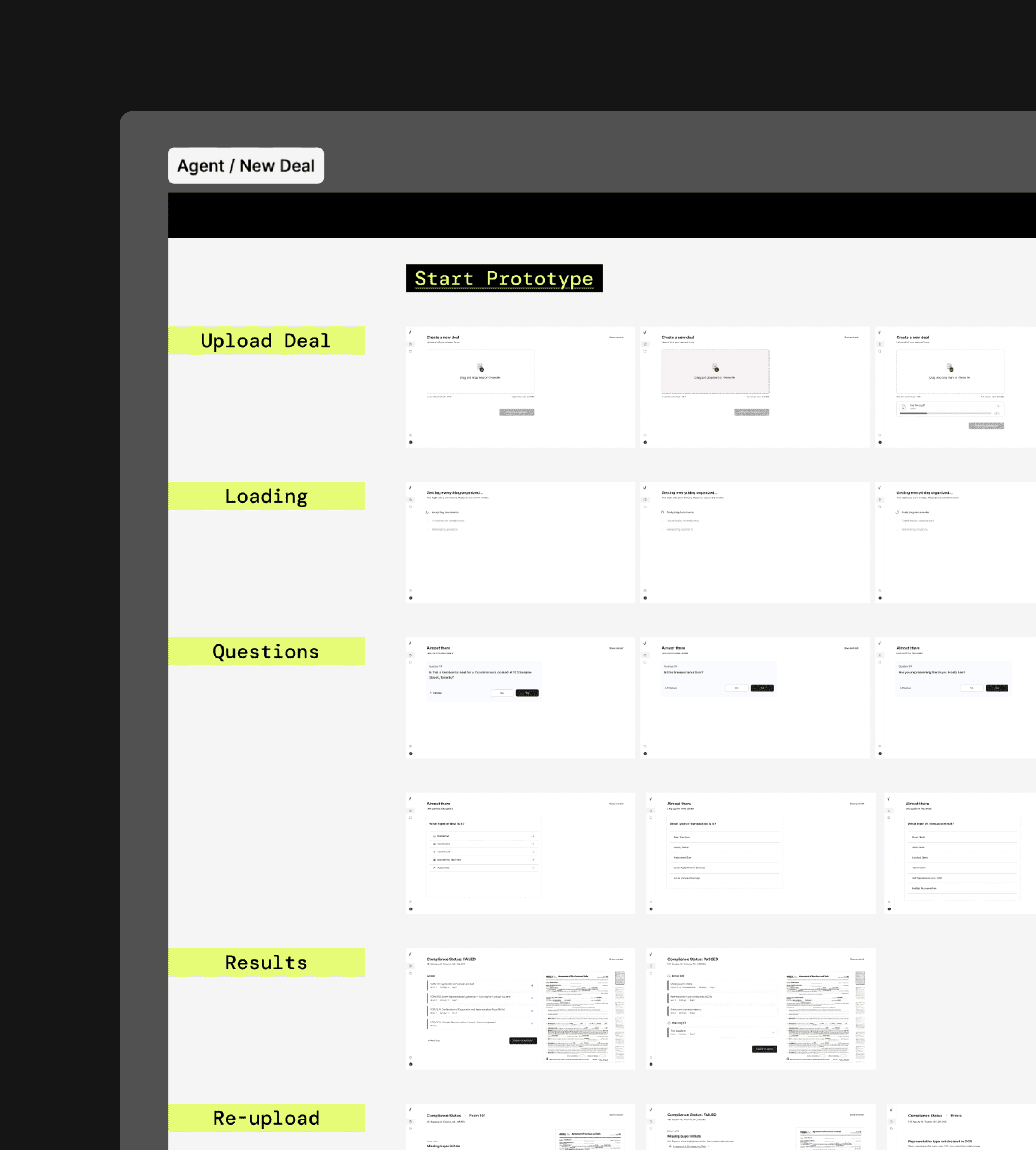
At the center of the solution was reframing compliance as a decision engine rather than a document problem. Instead of asking agents to know what they needed, I designed a progressive flow that narrowed the transaction step by step, from property type (house, condo, commercial) to transaction type (sale vs. lease), to representation and conditions, until the system could confidently generate the exact set of required TRESA forms.
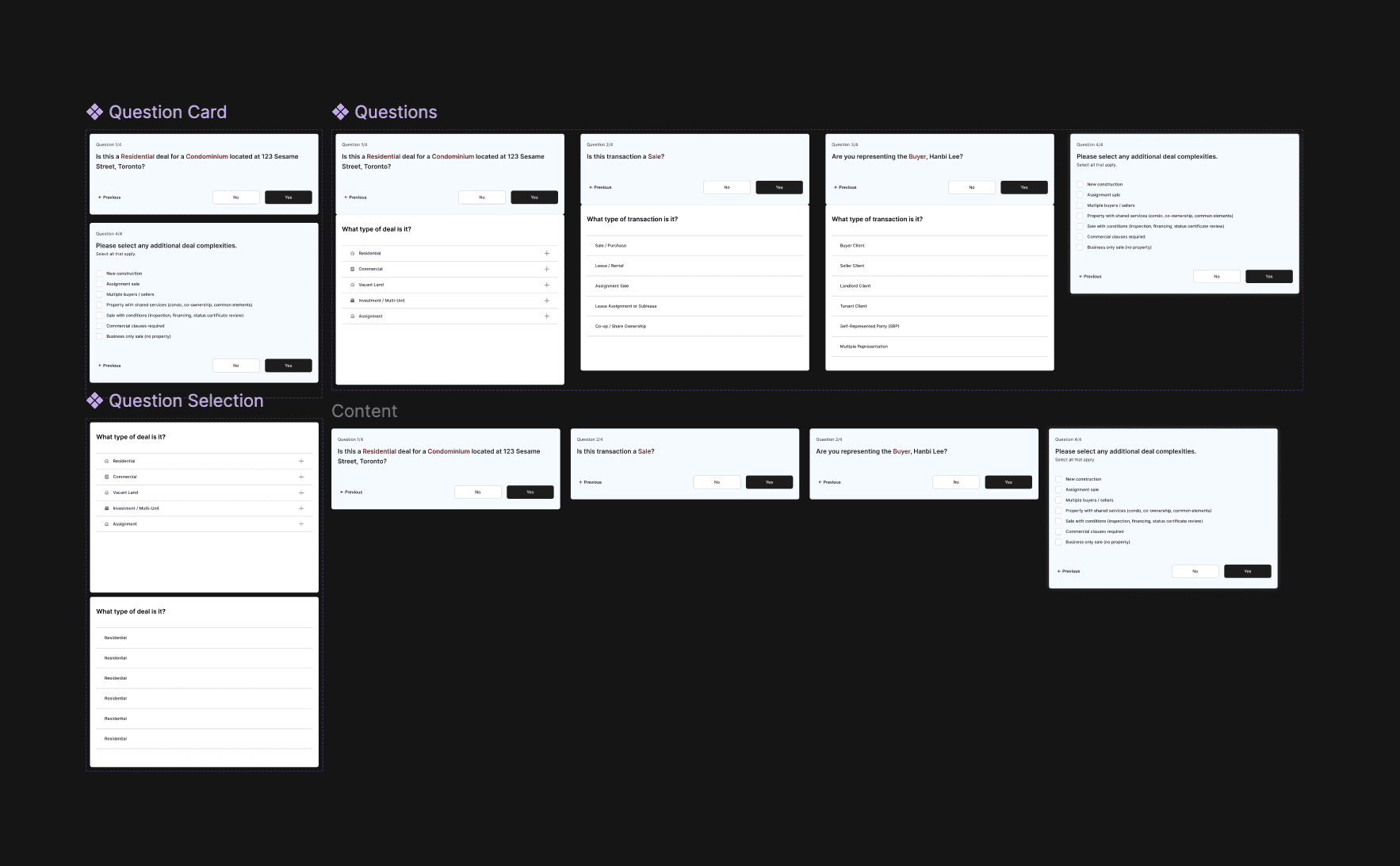
This required designing an interaction model that felt simple on the surface but encoded regulatory logic beneath it. Each question had to be unambiguous, defensible, and mapped cleanly to compliance outcomes. I focused heavily on language clarity, sequencing, and guardrails, ensuring agents always understood why a question mattered and how it affected their obligations.
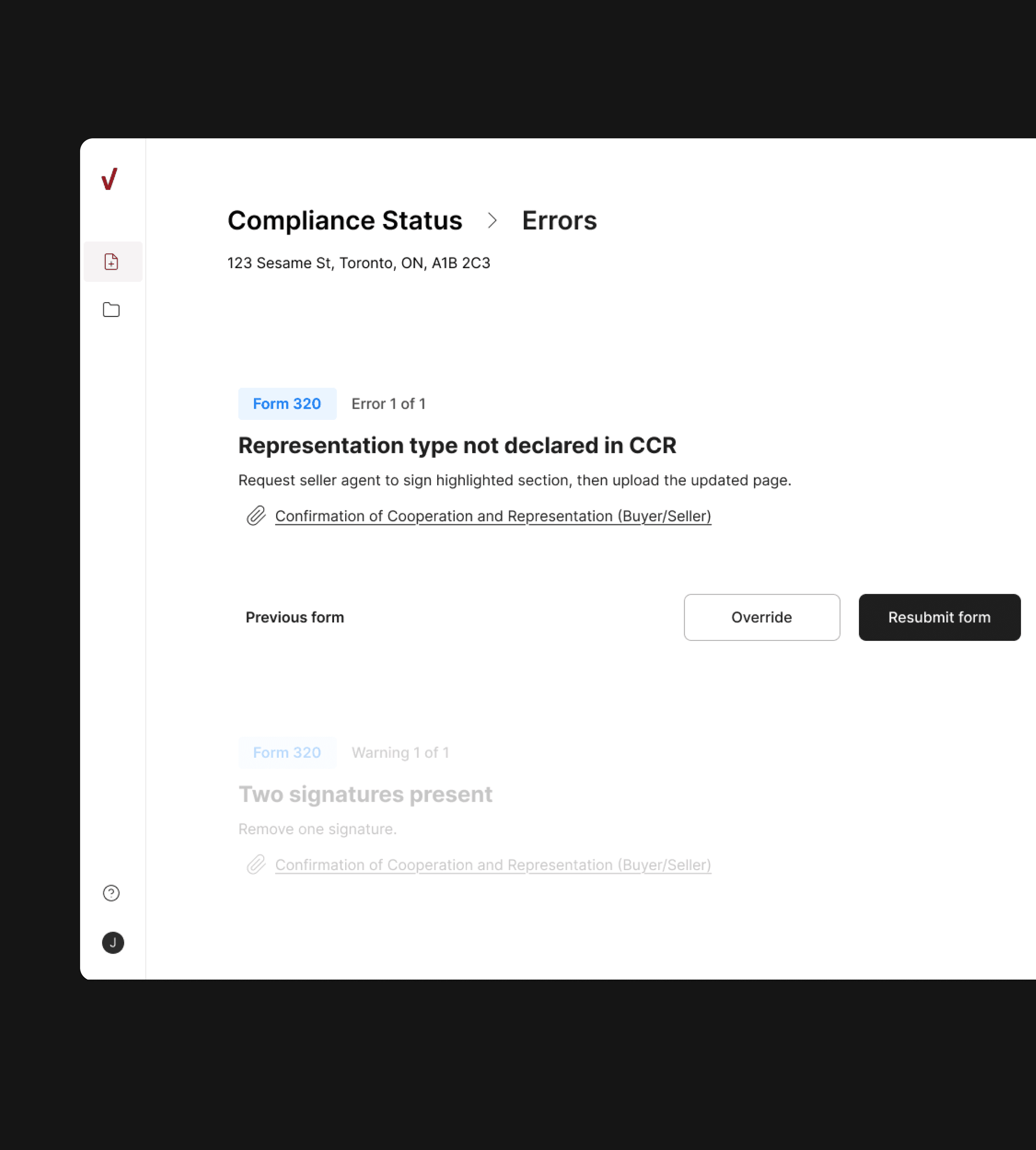
To move beyond static checklists, I explored how AI could act as both interpreter and safety net. The system surfaced form numbers, descriptions, and context-specific explanations, while remaining transparent and auditable which was critical for trust in a regulated environment. Rather than replacing professional judgment, the product supported it, reducing risk without removing agency.
I designed:
A guided transaction classification flow that narrowed deals into compliant form sets
Logic mapping between transaction attributes and TRESA form requirements
Clear, plain-language explanations for why each form was required
A scalable foundation for AI-assisted compliance checks and future automation
This project pushed me to design at the intersection of regulation, risk, and usability. It reinforced that in high-stakes domains, good product design isn’t about adding intelligence; rather, it’s about removing uncertainty. By turning opaque rules into a structured, explainable experience, we shifted compliance from something agents feared to something they could trust.
Verafy is an AI-powered compliance tool designed to help Ontario real estate agents confidently navigate transaction requirements without memorizing forms, edge cases, or regulatory nuance. The product had to solve a high-stakes problem: agents needed speed and certainty, while regulators and brokerages demanded accuracy and completeness. I led the product and experience design, with a focus on its core differentiator, translating complex regulatory logic into a guided, error-resistant workflow.
The problem wasn’t lack of information. Agents already had access to forms, checklists, and brokerage guidance. The real issue was cognitive load. Determining which forms were required depended on a tangled web of variables: property type, transaction type, representation structure, conditional clauses, and edge cases that changed obligations entirely. One wrong assumption could invalidate a deal. Compliance lived in agents’ heads, not in systems.
At the center of the solution was reframing compliance as a decision engine rather than a document problem. Instead of asking agents to know what they needed, I designed a progressive flow that narrowed the transaction step by step, from property type (house, condo, commercial) to transaction type (sale vs. lease), to representation and conditions, until the system could confidently generate the exact set of required TRESA forms.
This required designing an interaction model that felt simple on the surface but encoded regulatory logic beneath it. Each question had to be unambiguous, defensible, and mapped cleanly to compliance outcomes. I focused heavily on language clarity, sequencing, and guardrails, ensuring agents always understood why a question mattered and how it affected their obligations.
To move beyond static checklists, I explored how AI could act as both interpreter and safety net. The system surfaced form numbers, descriptions, and context-specific explanations, while remaining transparent and auditable which was critical for trust in a regulated environment. Rather than replacing professional judgment, the product supported it, reducing risk without removing agency.
I designed:
A guided transaction classification flow that narrowed deals into compliant form sets
Logic mapping between transaction attributes and TRESA form requirements
Clear, plain-language explanations for why each form was required
A scalable foundation for AI-assisted compliance checks and future automation
This project pushed me to design at the intersection of regulation, risk, and usability. It reinforced that in high-stakes domains, good product design isn’t about adding intelligence; rather, it’s about removing uncertainty. By turning opaque rules into a structured, explainable experience, we shifted compliance from something agents feared to something they could trust.