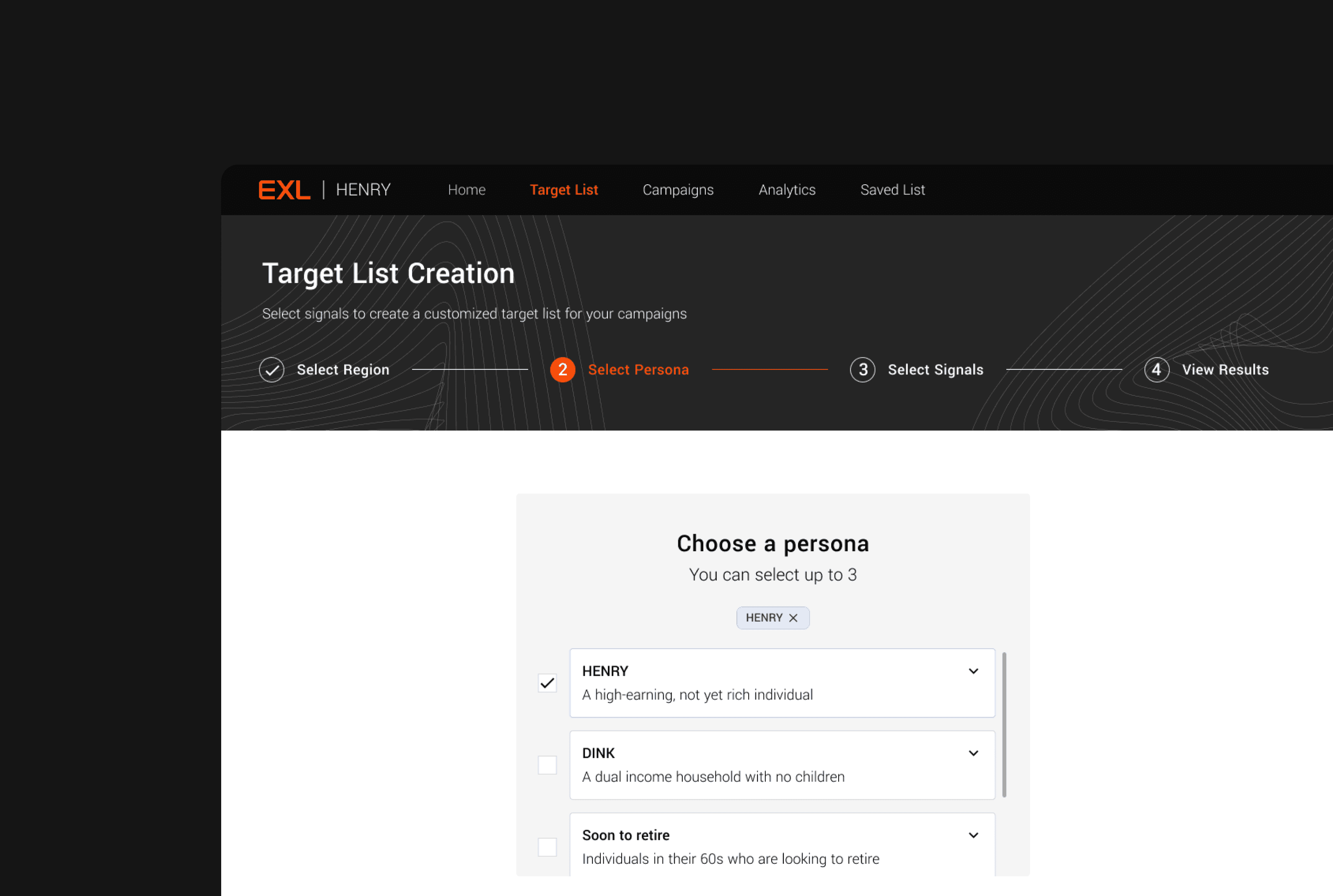
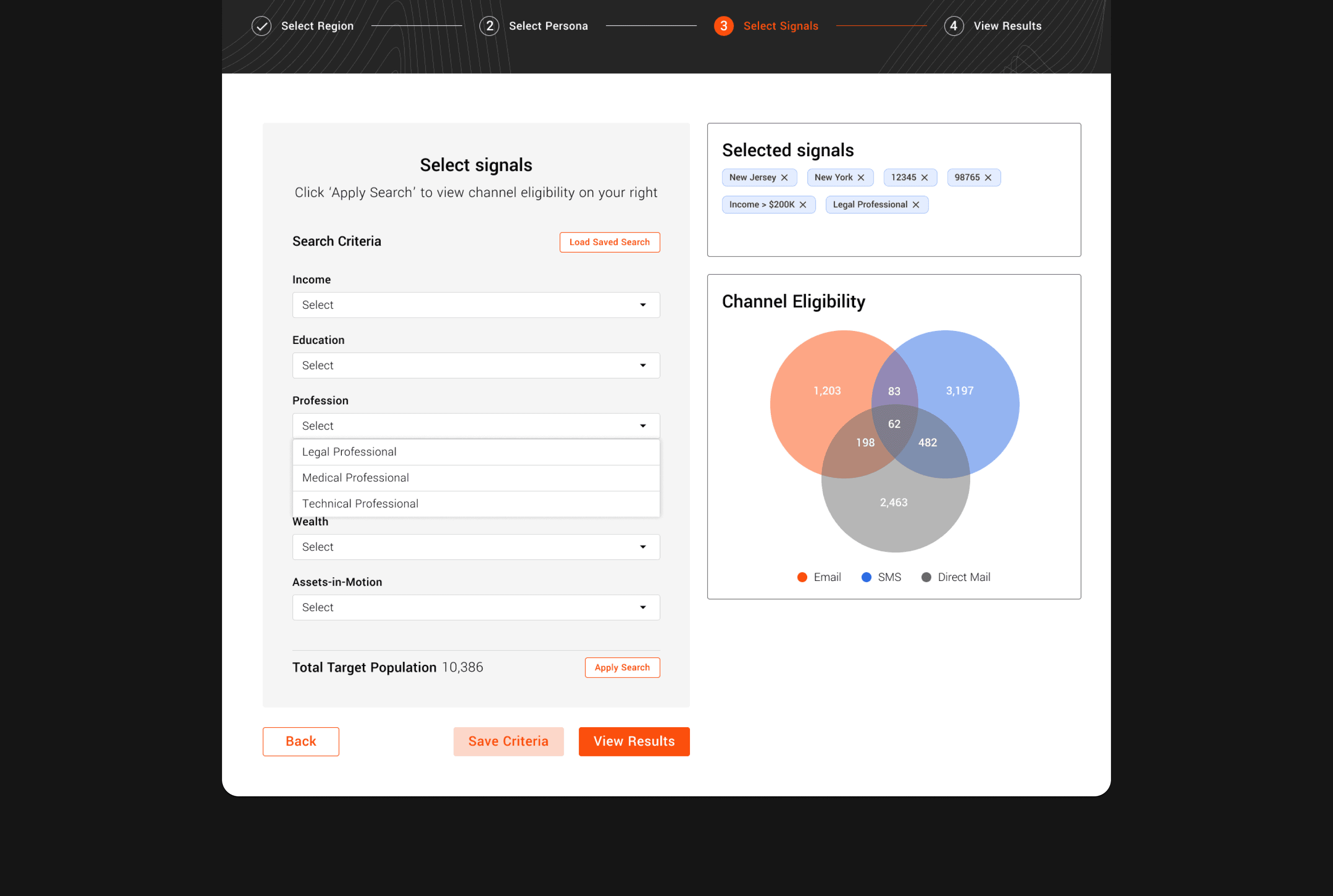
HENRY is a search and segmentation tool that helps wealth managers and financial institutions identify high-value prospects and activate campaigns targeted towards them. The product had to balance two competing needs: giving wealth managers the power to query complex financial datasets, while keeping the experience approachable enough to support fast, confident decision-making. For four months, I led the design of the entire product, with a focus on its core differentiator: the search and filtering system that powered target list creation.
The initial version of HENRY had strong market pull but struggled in practice. Through user interviews and usability testing, two issues became clear. First, complexity: users found the single-page search experience overwhelming and had difficulty completing core tasks. Second, feasibility: querying large datasets within one continuous interface introduced technical lag that degraded trust in the product. The challenge wasn’t just visual polish, but also rethinking how search should work in an enterprise context.
At the center of the redesign was a shift in the mental model. Instead of treating search as a single, exhaustive action, I reframed it as a guided segmentation journey. I employed an iterative design strategy grounded in three questions: How do we simplify without dumbing down? How do we encourage deeper engagement with the data? And how do we design for future scalability?
That led to a focused reduction in scope. I trimmed low-value features and distracting visualizations, prioritizing clarity and task completion over breadth. To address both usability and performance constraints, I redesigned the user journey into a segmented, multi-step flow. Each step focused on a single decision, reinforcing progress and enabling asynchronous data loading behind the scenes. Stakeholder-requested features, like client persona selection, were introduced early in the flow to immediately narrow scope and help users feel oriented from the start.
The result was a markedly more usable product. In the second round of testing, users were able to complete end-to-end workflows with confidence, navigate complex datasets without friction, and clearly understand how their inputs affected outcomes. The segmented approach resolved critical usability and technical issues while establishing a flexible foundation for future expansion, including anticipated GenAI-powered capabilities.
HENRY reinforced a core lesson in my product thinking: power doesn’t come from complexity. It comes from restraint, clear language, and strong hierarchy. By simplifying the experience and designing around how users think (as opposed to how systems work) we turned a promising idea into a product people could actually use.